Scotland's West Highland Line: The Most Romantic Railway Journey in Britain
 L. Carver
Few railways earn the word romantic without irony. Scotland's West Highland Line earns it on every curve.
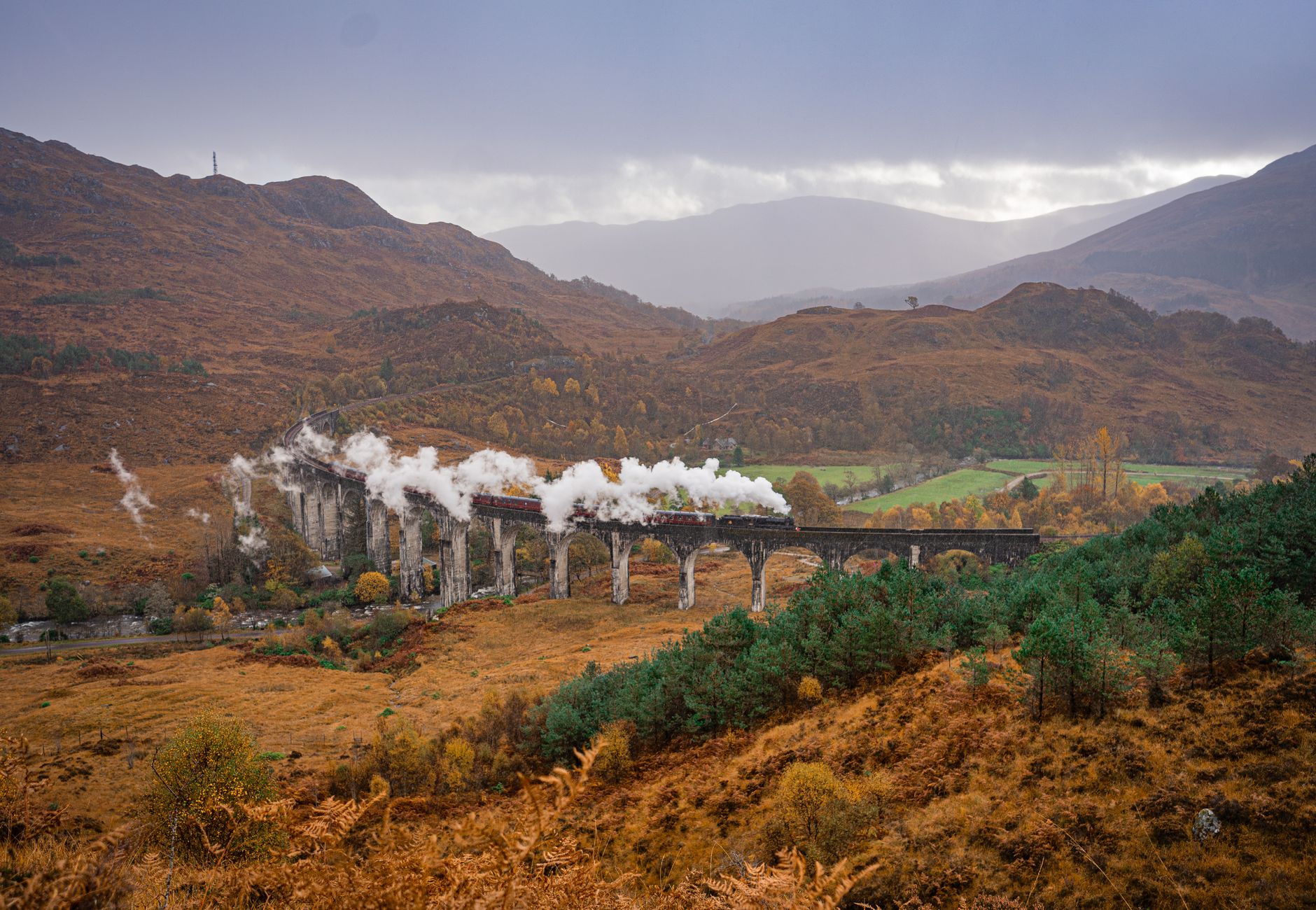 Photo by Clément Proust on Pexels.
Stretching 164 miles from Glasgow Queen Street north to Mallaig, a small fishing port on the edge of the Atlantic, this route passes through moorland that looks ancient enough to predate maps, alongside lochs so still they double the sky, and over a viaduct that has appeared in more films than most actors. It's not the fastest way to get anywhere. That's entirely the point.
The Route at a Glance
The line splits at Crianlarich, roughly halfway through the journey. One branch continues west to Oban; the other heads north toward Fort William and eventually Mallaig. If you're choosing between them, the Mallaig extension wins, barely, because of Glenfinnan.
Glenfinnan Viaduct is the centrepiece: a 21-arch curved structure built in 1898 using mass concrete, a relatively new technique at the time. You'll recognize it from the Harry Potter films, where the Hogwarts Express steams across it. In person, it's more impressive than any film frame captures, particularly when the train slows, as it tends to, and you look down into the valley floor far below.
From Fort William, the Jacobite steam train runs seasonally on the same tracks to Mallaig. It's a tourist service, deliberately so, and worth every penny of the premium if you care at all about watching steam curl over Scottish moorland.
When to Go
May and June offer the clearest skies and longest daylight, you'll still have light past 10pm in the Highlands, which does strange and wonderful things to the hills. September holds the colours: bracken turns copper, heather fades to rust, and the angle of light drops low enough to make everything look like a painting someone worked on for decades.
Winter is not for the faint-hearted, but it has its own argument. Snow on Ben Nevis, frozen lochs, and carriages that feel even more like refuge against the weather outside. Go knowing what you're signing up for.
Practical Details Worth Knowing
ScotRail operates the regular service daily. The full Glasgow-to-Mallaig journey takes approximately five hours and forty minutes, though that figure varies with connections. Seat reservations are required on the Jacobite steam service; on regular ScotRail trains they're recommended but not mandatory, book ahead on summer weekends, when the line draws serious crowds.
Sit on the right-hand side of the train heading north for the best views of Loch Lomond. Switch to the left after Crianlarich, where the loch gives way to open glen and the line climbs toward Rannoch Moor, one of the most desolate stretches of railway in Europe, a blanket bog so vast and waterlogged that the track had to be floated on a mattress of brushwood and peat during construction.
That detail alone tells you something about the ambition it took to build this line.
The Stations Are Part of the Journey
Rannoch station sits in the middle of nowhere. Literally: there's no road access, only the railway and a small hotel that has been feeding stranded travellers since the line opened in 1894. Corrour station, the next stop, sits at 1,350 feet above sea level, the highest mainline station in Britain, and became briefly famous when it appeared in Trainspotting. Neither station has a village attached. Both have a quality of remoteness that feels genuinely rare in the modern world.
Mallaig, at the end of the line, smells of salt and diesel and fresh-caught seafood. There's a small harbour, a handful of places to eat, and ferries running to Skye and the Small Isles. Spend a night if you can. Rushing back the same day misses the whole spirit of what this railway offers.
Why This Line Matters
Scotland's West Highland Line was never built for speed. It was built, at enormous cost, over hostile terrain, to connect remote communities to the rest of the country. That original purpose has faded as road transport took over; today, the line survives partly on tourism, partly on freight, partly on the stubbornness of the communities that still depend on it.
Riding it feels like participating in something that almost wasn't preserved. Which makes every mile feel a little more worth paying attention to.
Get Rail Retreat in your inbox
New posts delivered directly. No spam.
No spam. Unsubscribe anytime.