The Bernina Express: Switzerland's Most Dramatic Alpine Rail Journey
 L. Carver
Few rail journeys make you genuinely forget to breathe. The Bernina Express is one of them.
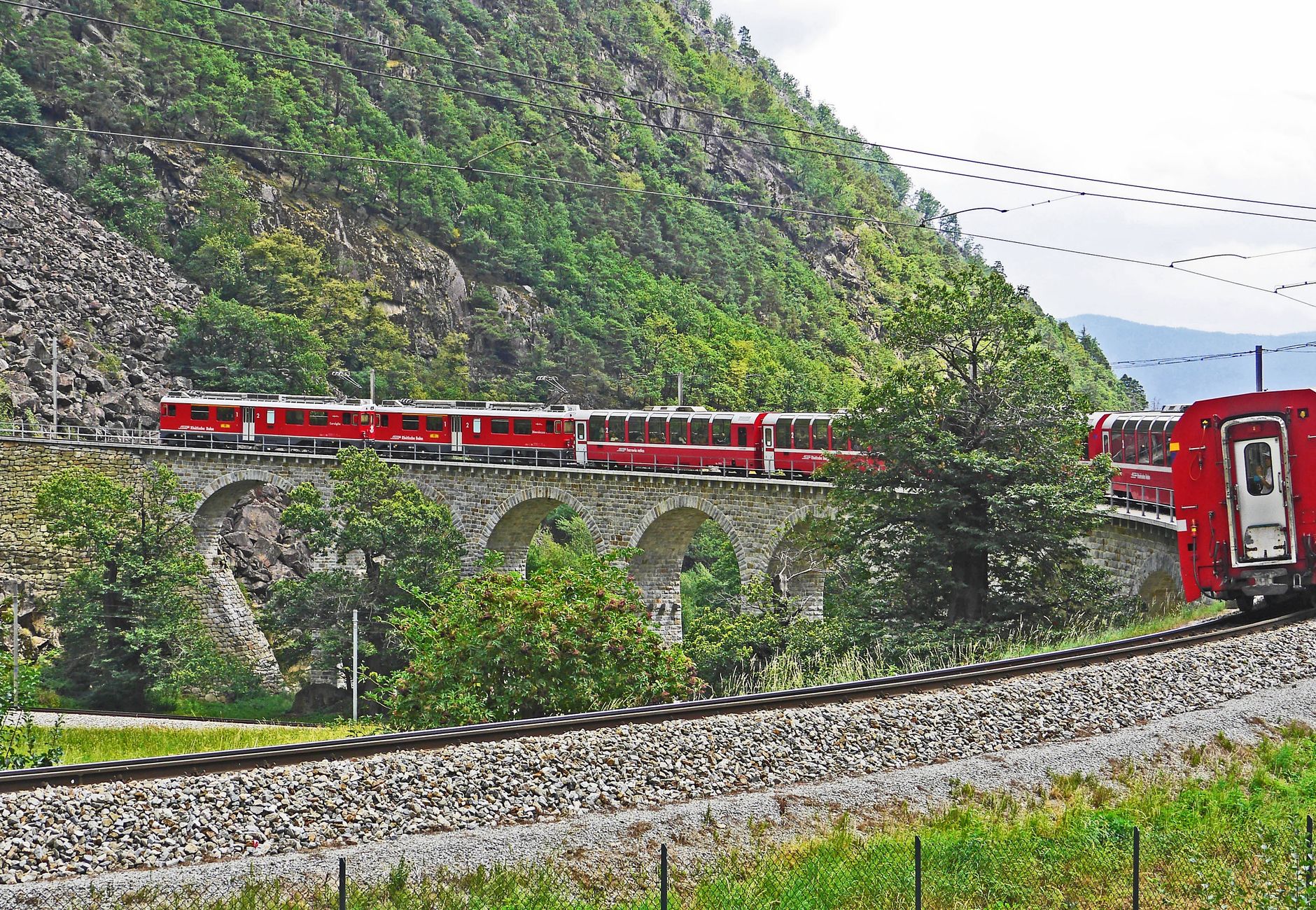 Photo by
 Stretching 144 kilometres between Chur in Switzerland and Tirano in northern Italy, this narrow-gauge line climbs to 2,253 metres above sea level, the highest point on any non-rack Alpine railway in Europe. No cog wheels. No cable assists. Just an engineering triumph carved into the mountain over a century ago, still running daily through glaciers, viaducts, and stone-village valleys.
Unesco designated the Rhaetian Railway (of which the Bernina line forms a part) a World Heritage Site in 2008. That recognition is warranted. But the numbers alone don't explain why people ride this route year after year, in every season. That requires a window seat.
What to Expect on Board
The Bernina Express runs as a themed panoramic service operated by Rhaetian Railway (RhB), though the underlying line itself is served by regular regional trains too, something worth knowing if you're on a tighter budget. The panoramic cars feature oversized windows, angled slightly upward, specifically designed to keep mountain peaks in frame rather than cutting them off at the roofline. It's a small design decision with an enormous payoff.
Journey time from Chur to Tirano runs roughly four hours. From St. Moritz, where most travellers actually board, it's closer to two and a half. Either way, this is unhurried travel by design; the train averages around 30 km/h across the full route, not because it can't go faster, but because the terrain simply won't allow it.
Seat reservations are mandatory for the panoramic express service and cost a few Swiss francs on top of your standard ticket. Book early in summer. July and August fill up weeks in advance.
The Highlights You Won't Want to Miss
Between St. Moritz and Tirano, the scenery shifts so dramatically that the route feels like three different journeys stitched together.
The Montebello Curve comes early, just after Morteratsch station. Here, the train bends around a sweeping arc offering a direct view of the Morteratsch Glacier, one of the most photographed glaciers in Switzerland, and one that has retreated by several kilometres since the railway was built in 1910. The contrast between archive photos and today's view is sobering.
Ospizio Bernina, at the summit, sits beside the luminous turquoise Lago Bianco. In winter the lake freezes completely and the surrounding peaks are buried under snow; in late spring, the ice cracks into drifting plates. Both versions are worth seeing.
From the summit, the line begins its steep descent into Italian-speaking Poschiavo. This is where the Brusio Spiral Viaduct appears, a full circular loop built to lose elevation without exceeding the line's strict gradient limit. The train curves inside itself, crossing over its own tracks. Watching it from the outside is extraordinary; experiencing it from within, watching the valley rotate around you, is disorienting in the best possible way.
Practical Planning: Chur vs. St. Moritz as a Starting Point
Most travellers begin in Chur, because the full route provides more variety: the Albula line from Chur to St. Moritz is itself a UNESCO-listed wonder, threading through sixty-five tunnels and over nearly two hundred bridges before the Bernina section even begins. Starting here adds roughly two hours, and an entirely different chapter of scenery.
That said, St. Moritz is the more convenient entry if you're coming from Zurich or the central Swiss rail network. A direct InterCity service from Zurich to Chur takes about 70 minutes; Chur to St. Moritz via the Albula line is another two hours from there.
At the Italian end, Tirano connects onward to Sondrio and Milan via Trenitalia. Crossing into Italy by train, with no passport queue, no security line, just a seamless roll across the border, that's the particular pleasure of European rail travel that no flight can replicate.
When to Go
Honestly? Any season works, and each makes a completely different case for itself.
Winter turns the route monochromatic and otherworldly, frozen lakes, snow-laden pines, the occasional red train cutting through white silence. Summer brings lush Alpine meadows and clear glacial views. Autumn offers golden larch forests across the Engadine valley; the larches turn in October and the colour is genuine competition for anything the Canadian Rockies produce.
Spring is the underrated option. Snowmelt runs in cascades beside the tracks, the crowds haven't arrived, and prices are lower across the board.
One Last Thought
What makes the Bernina Express worth writing about, worth riding, isn't any single viaduct or summit view. It's the cumulative effect of four hours at mountain pace, watching the world reorganise itself outside the glass. Modern travel trains us to move through places as efficiently as possible. This line trains you to stop moving and simply look.
That's the point of slow travel. And here, the train does the slowing for you.
Get Rail Retreat in your inbox
New posts delivered directly. No spam.
No spam. Unsubscribe anytime.